Why a Village Hall Needs a Clear Welcome
A clear welcome in a village hall helps newcomers find the entrance, work out where to go and join a gathering without guessing or interrupting.
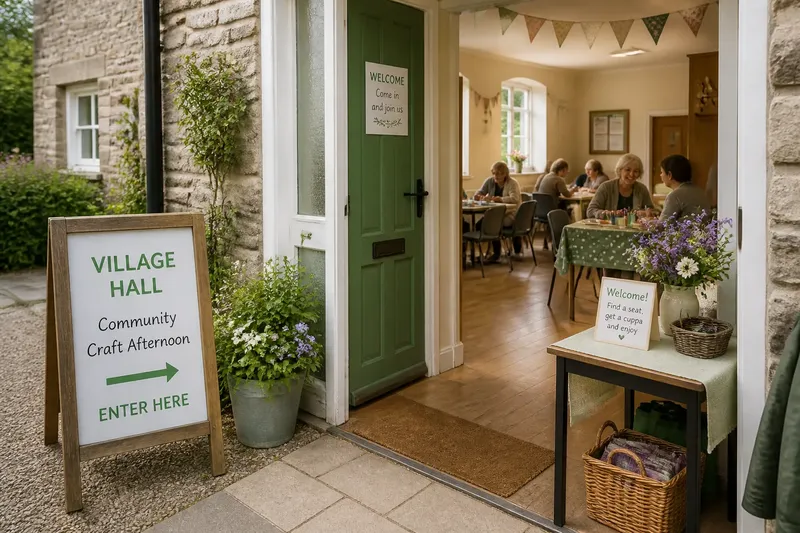
A clear welcome in a village hall starts before anyone says hello: the entrance, arrival point and room layout should tell a newcomer what to do next. When these cues are missing, even a friendly gathering can feel like a private appointment whose location has been mislaid.
The right welcome depends on the hall and the event. A weekly coffee morning, a meeting in a side room and a busy supper all make different demands. Choose signs and room arrangements for the actual arrival, rather than adding a general notice and hoping it explains everything.
What kind of arrival does your hall need?
Start by watching the route a first-time visitor is likely to take: from the road or car park to the door, then from the door to the gathering. Do not assume that the door used by regulars is obvious, or that a glimpse of chairs means a newcomer knows whether to enter.
- If people arrive while the hall is locked or in use: make the correct entrance and any waiting point clear. A small sign at eye level can say which door to use and whether to knock or wait.
- If the hall has several entrances: identify the one that leads to the event. If another door is needed for access or serves a separate room, direct visitors from the main approach rather than leaving them to try handles.
- If visitors arrive in a steady stream: place a greeter where they can see the door and the room. That person can point out coats, seats and refreshments without making each arrival stop the conversation.
- If arrivals are occasional or the event is informal: use a brief, visible sign at the entrance and a simple cue inside, such as a table with a welcome note. A staffed reception desk is probably more ceremony than the occasion needs.
Say you are arranging an informal craft afternoon in a hall with a front door and a side door. If the side door is the one normally left open, put a clear event sign on the approach and a welcome note just inside, then set the activity tables so the entry route remains visible. A newcomer should be able to identify the gathering and choose where to go without crossing between people who are already working.
How should the entrance explain itself?
A useful sign answers an immediate question. “Village hall” names the building; “Community lunch — enter here” tells someone what is happening and where to go. Keep wording short, use lettering that can be read from the approach, and give the event name or room when the building contains more than one activity.
Place signs where a person makes a decision: at the gate or path junction if the route is unclear, on the door if several look alike, and inside if the event is not visible from the entrance. Avoid a trail of arrows that all point towards a corridor. One clear direction at the right turn is more helpful than several signs that say little.
For a recurring gathering, a reusable sign can carry the regular event name, with a changeable card for the day’s details. A chalkboard can work where it is protected from rain and someone is responsible for updating it. A laminated sheet may be durable, but an old event date left in place has a particular talent for undermining confidence.
Check the view from a seated height as well as standing height if visitors may use a wheelchair or move slowly. Keep signs away from door swings and narrow passages. The event organiser can choose the message and placement; rules for signs, access and fire routes may depend on the hall’s instructions and local requirements.
Where should the first point of arrival sit?
The arrival point is the first place where a visitor can pause and understand the room. It may be a welcome table, a greeter beside the door or simply an uncluttered space with a note and a clear view. It need not resemble a reception desk. Its job is to answer “Am I in the right place?” and “What can I do now?”
For a meeting where people sign in, put the sign-in sheet and pens where they can be reached without blocking the doorway. For a drop-in gathering, a small card can name the host or say that visitors may choose any open seat. If coats, buggies or walking aids need somewhere to go, indicate a suitable place rather than letting the entrance become a storage experiment.
Do not put the welcome table directly across the natural route into the room. A visitor carrying a dish, holding a child’s hand or arriving with a mobility aid should not have to negotiate a queue before seeing where the event is. Leave the approach clear and put the information just to one side.
What room layout makes joining easier?
Arrange the room so that a newcomer can see both the activity and a reasonable place to join it. Rows facing a speaker suit a talk, but can make late arrivals feel conspicuous if the only route runs in front of everyone. A meeting with discussion may work better with seats arranged so participants can see one another and a gap remains for entry.
For a social gathering, avoid placing all the chairs in a tight circle that seems closed before anyone arrives. Leave a few seats at the edge and keep the route to refreshments and toilets legible. For a shared meal, make the serving area clear and keep a separate path for people who are not yet ready to join the queue.
Furniture should help people participate, not demonstrate the organiser’s ability to move trestle tables. Keep aisles open, avoid loose cables across walking routes, and do not use a chair or table to conceal an exit. If the room has a fixed layout, work with the space: use a sign or greeter to explain where newcomers can sit rather than rearranging equipment that must remain in place.
Which welcome suits your gathering?
What works for a drop-in coffee morning?
Use a visible event sign, an open route to the refreshments and a greeter or welcome note near the door. Leave a few seats easy to choose, so visitors do not have to ask whether a place is being saved.
How should a formal meeting receive newcomers?
State the meeting name and room at the entrance, then place sign-in materials beside—not across—the route in. A named host near the door can explain the seating arrangement and point out where late arrivals may sit.
What helps when several activities share the hall?
Give each activity a clear room name or destination and show the direction at the point where routes divide. A visitor should not have to enter one group’s room to ask where another group meets.
What if the event has no dedicated greeter?
Use a short note inside the entrance that names the gathering and gives one next action, such as choosing an open seat. Keep the room visible from the door where possible; a note cannot compensate for a maze of furniture.
How can you check the welcome without making a production of it?
Before the event, stand outside and follow the signs as if you had not been to the hall before. Check whether you can identify the entrance, see what is happening and find a route to a seat without asking someone to move. Then look back towards the door from inside: can a late arrival tell where to go without interrupting the whole room?
Ask someone unfamiliar with the event to make the same short walk, if that is convenient. Invite them to say where they hesitated, rather than asking whether the hall looks welcoming. A specific pause at a dark corridor or an unmarked second door gives the organiser something useful to change.
Keep the remedy proportionate. A paper sign, moved table or clearer seating gap may solve the problem; a printed welcome pack, branded banners and a committee discussion about the exact shade of green usually will not. The useful test is whether a newcomer can arrive, orient themselves and join in with ordinary ease.
A clear welcome in a village hall is not a decorative extra; it is a small piece of shared hosting. Make the entrance legible, give people a place to pause, and arrange the room so participation has an obvious route. The most convincing welcome may be no more elaborate than an open door, a readable sign and a chair that does not look reserved for someone important.